 The Sports Guru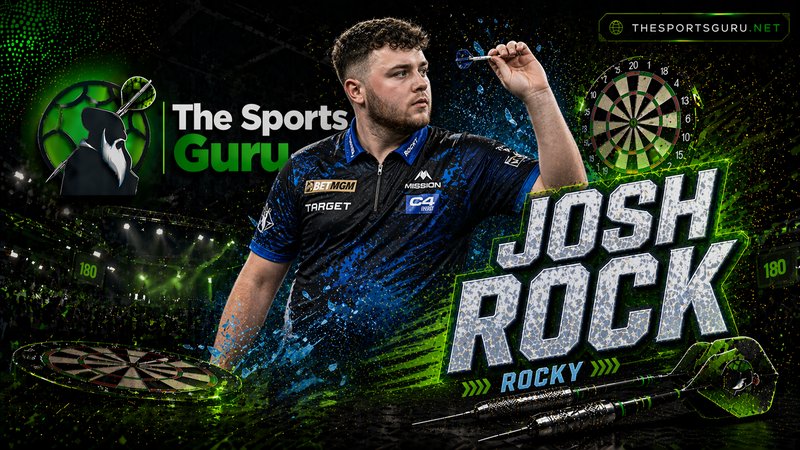
Josh Rock's victory in Graz was built on nerve, precision, and one moment of maximum-pressure brilliance. This piece unpacks the turning point that decided the final, traces how both finalists arrived at Sunday evening, and considers what Rock's win means for his season going forward.
Three years ago Josh Rock stood in this same Graz arena and watched another player lift the green jacket. On Sunday night in Austria he made sure there would be no repeat, pinning double 12 at a critical juncture and double tops in the deciding leg to beat Kevin Doets 8-6 and become the Austrian Darts Open champion for the first time. It is his second PDC European Tour title overall, and arguably the most emotionally loaded win of his career so far.
The result did not follow a tidy script. Doets, who had been in irresistible form across the entire weekend, broke back to level at 6-6 after Rock stumbled on a straightforward hold. The match could easily have gone the other way. That it did not is a testament to Rock's ability to recover quickly and punish a miss from his opponent in the very next leg. In a final of this nature, the gap between winning and losing was, quite literally, a single double.
Rock averaged 101.56 across the match, a number that reflects consistent rather than spectacular scoring, which makes his victory all the more revealing. A three-figure average is a respectable baseline in a European Tour final, but it is rarely the mark of a player who has dominated from wire to wire. This was not a performance where he blew Doets off the stage; it was one where he absorbed pressure, responded to adversity, and produced his one genuinely decisive moment at the exact instant it mattered most. That tells you something about where his game is in May 2026.
The Moment That Decided It: Leg Seven and the Big Fish
Darts finals often hinge on a single checkout, and this one was no different. At 3-3, with the match delicately balanced, Rock landed the 'Big Fish' 170 checkout in the seventh leg to break throw and move 4-3 in front. The maximum finish, requiring treble 20, treble 20, and the bullseye, is the sport's most celebrated three-dart combination on a live board. Statistically, it is also among the rarest: landing it in a European Tour final, against an opponent in the form of his life, is the kind of moment that shifts the psychological weight of a match in an instant. The thrower who has just been broken at that stage of a final faces a fundamentally different match to the one they were playing two minutes earlier.
It did not finish things immediately. Doets responded with real composure, taking out 90 in the 12th leg to break back and restore parity at 6-6. Rock had failed to hit single 20 and left the door open; the Dutchman was precise enough to walk through it. For a brief period, the green jacket looked like it might be heading to the Netherlands. But the next leg told a different story. Doets needed 80 to hold his throw and could not find it. Rock stepped in, pinned double 12 to break back immediately, and moved to within a leg of the title. He then held his own throw to close out 8-6, checking out 60 on tops to seal it.
The pattern of those closing legs illustrates a recurring truth at this level: momentum in darts can reverse inside two minutes. Rock's response to being pegged back at 6-6 was not to play safe or to try and grind Doets down. He played his natural game, capitalised on a missed double from his opponent, and that proved to be enough. It is a quality that separates the European Tour winners from those who make the latter stages and no further.
How Rock Navigated a Difficult Draw
Rock's route to the final was far from straightforward. In the last 16 he survived match darts from German opponent Niko Springer before edging through 6-5. That result, squeezed rather than comfortable, might have rattled a player less certain of his own game. Instead, Rock used it as a foundation. He beat Saturday's nine-dart hero Cristo Reyes 6-4 in the quarter-finals, a result that required him to deal with a crowd already energised after Reyes had produced a perfect leg against Damon Heta the previous day. Beating a player carrying that kind of momentum, with an excitable crowd behind them, demands a particular kind of focus that does not show up in averages.
The semi-final against Daryl Gurney, his fellow Northern Irishman, was where Rock truly hit his stride. He won 7-3, nailing three ton-plus checkouts including a match-clinching 145. When a player is finishing at that level against a competitor of Gurney's experience, it suggests real confidence rather than fortune. Rock arrived at the final with momentum behind him, which matters enormously in a tournament compressed into a single weekend.
It is worth noting that Rock had twice before fallen short in Graz. He lost the 2023 final to Jonny Clayton and was beaten by Martin Schindler in last year's semi-finals. Two successive near-misses in the same city could easily have planted doubt; instead, Rock channelled the frustration productively. He referenced both defeats directly after the match, which suggests this victory mattered to him as a point of personal resolution rather than simply another ranking event on the calendar.
Doets: A Finalist Who Leaves Austria With His Reputation Enhanced
Any account of the Austrian Darts Open that focuses solely on Rock risks underplaying what Kevin Doets produced across Sunday's finals day. The Dutchman, ranked 33rd in the PDC Order of Merit, arrived in Graz having won his maiden PDC ranking title at the Players Championship in Hildesheim earlier the same week. He was, by any reasonable measure, the most in-form player at the tournament.
He beat Ryan Joyce 6-2 to open the afternoon session, then produced a 170 checkout of his own and averaged more than 112 in a 6-3 quarter-final win over Luke Woodhouse. The semi-final against Rob Cross was where Doets made his most emphatic statement: a 7-3 win, completed with a 124 finish, against a former world champion who had earlier ended Michael van Gerwen's campaign in the last 16. Cross is not a player who fades quietly from tournaments; removing him so convincingly demonstrated both the quality and the confidence Doets currently possesses. That 112-plus average against Woodhouse also matters as a data point: it is the kind of scoring that suggests a player in genuine rhythm, not one scraping through on opponents' errors.
Rock, for his part, was generous and perceptive in his assessment of the runner-up. "Kevin has been playing unbelievable this year," he said after collecting the green jacket. "He proved it by winning his first Pro Tour and he's only going to keep winning more. I'm just grateful I got the edge against him in this one. Everyone needs to watch out because Kevin's in a good bit of form at the minute." That kind of acknowledgement, from a player who has just beaten someone, carries more weight than routine post-match courtesy. Rock appeared to mean it.
From a tactical standpoint, Doets' ability to produce a 170 of his own in the quarter-final suggests he was not relying on grinding opponents down through attrition. He came to Graz as an attacking player in form, and he left having reached the final of a major European Tour event days after his first ranking win. At 33rd in the world, he is approaching the point where consistent results will push him into the top tier of the tour in a way that will make him very difficult to avoid in draws going forward.
What the Green Jacket Means for Rock's Season
The timing of this win is significant context. Rock is currently bottom of the Premier League Darts table, a position that invites scrutiny and, in some quarters, concern about the consistency of his form at the highest weekly level of the sport. Winning a European Tour event in that context does not solve the Premier League problem directly, but it does demonstrate that his ability to perform in finals and close out tight matches remains intact. Those are not trivial qualities to confirm under pressure. There is also a structural point worth making: the Premier League and the European Tour demand different things from a player. The weekly grind of the Premier League, with its fixed opponents and cumulative pressure, is a different beast to the single-weekend burst of a European Tour event. Rock's results in the latter format suggest his peak-performance level is in good order, even if he has not yet found the sustained consistency the Premier League requires.
Rock's two European Tour titles now sit alongside his runner-up finish at this same event in 2023, which tells its own story: he is a player who performs on the European Tour stage and who has learned to convert appearances in finals. His first European Tour win, the Dutch Darts Championship in 2024, was a significant milestone. This second one, hard-fought and emotionally resonant given his history in Graz, may prove to be the more important of the two in terms of what it signals about his development as a competitor.
He also drew an approving parallel that will resonate with sports fans across Northern Ireland. Noting that compatriot Rory McIlroy had won a second Masters title in golf a few weeks earlier, Rock said: "Titles are very hard nowadays to win in any respect because the standard's that good. To come here this weekend and win is a massive achievement. I'm just happy because two Northern Irishmen got a green jacket this year!" The Masters comparison is light-hearted, but the point about standards is a serious one. The European Tour draws a genuinely competitive field, and winning it requires performing across multiple matches over two days with no margin for a prolonged bad spell.
What Rock produces in the remaining weeks of the Premier League season will determine whether Sunday's victory becomes a turning point or simply an encouraging aside. But the qualities he showed in Graz, namely the ability to produce a critical checkout at 3-3 in a final, the resilience to respond immediately when broken at 6-6, and the composure to close out a deciding leg, are precisely the qualities that translate to sustained success at the top level. He is 24 years old. The Austrian Darts Open green jacket, finally his after two near-misses, may be the first of several chapter endings he writes in Graz.
Frequently Asked Questions
The 170 checkout, known as the "Big Fish," requires a player to hit treble 20, treble 20, and then the bullseye in three successive darts. It is the highest possible finish in darts and is considered the sport's most celebrated three-dart combination on a live board. Landing it in a European Tour final, as Rock did at 3-3 in the seventh leg, is statistically among the rarest occurrences in the professional game.
Doets took out 90 in the 12th leg to break back after Rock failed to hit single 20 and left the door open. The Dutchman was precise enough to capitalise on that miss and restore parity, demonstrating the composure that had characterised his form across the entire weekend. At that point, the match could credibly have gone to either player.
A three-figure average is a respectable baseline in a European Tour final but it is not the mark of a player who dominated throughout. Rock won not by blowing Doets off the stage but by absorbing pressure, recovering from adversity, and producing one decisive moment at the critical juncture. The average reflects consistency rather than spectacular scoring, which makes the nature of his win particularly revealing about his current game.
After Doets levelled at 6-6, he needed 80 to hold his own throw in the next leg but could not find it. Rock immediately capitalised by pinning double 12 to break back and move to within a leg of the title. He then held his own throw, checking out 60 on tops, to close out the match 8-6.
This is Rock's second PDC European Tour title overall, not his first. The article describes it as arguably the most emotionally loaded win of his career so far, partly because he had previously stood in the same Graz arena and watched another player lift the trophy. He also defeated Daryl Gurney 7-3 in the semi-final on his way to claiming the £35,000 first prize.
Sources: Reporting draws on PDC European Tour coverage, with results and statistics verified against official PDC tournament records.