 The Sports Guru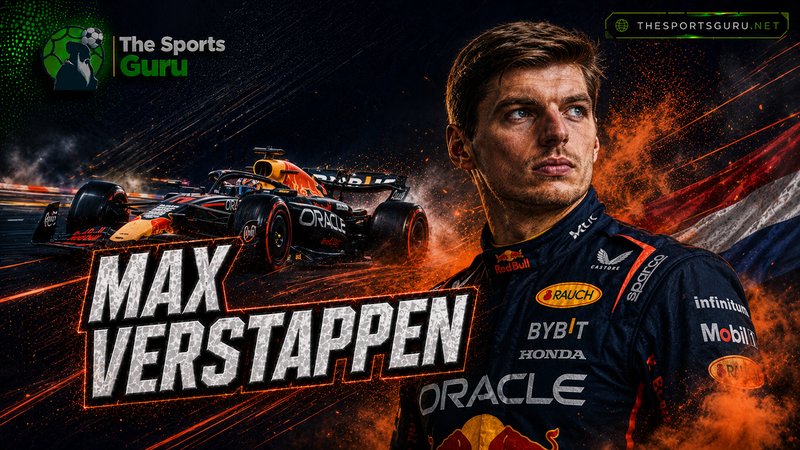
Why would a four-time champion sign through 2030 while sitting sixth in the drivers’ championship and without a win in 2026? This piece explains why Max Verstappen’s decision rests less on Red Bull’s present form than on whether Formula 1 can make racing feel worth his time again.
Max Verstappen has chosen the team over the temptation, but the more revealing choice was Formula 1 over the exit door.
His Red Bull extension until the end of 2030 lands awkwardly against the immediate picture. The four-time champion is sixth in this year’s drivers’ championship, Red Bull have endured a difficult 2026, and Verstappen is still waiting for his first victory of the season. Mercedes had long pursued him. McLaren had also held talks, while his friend and long-time race engineer Gianpiero Lambiase is due to move there by 2028 at the latest.
Those facts make a transfer story easy to write. They do not quite explain the contract. Verstappen had first to decide whether the new Formula 1 itself was sufficiently enjoyable to continue in. Only then did Red Bull become the question. His answer suggests that the sport’s gradual retreat from the most frustrating effects of its new power-unit rules, alongside a team prepared to accommodate the rest of his racing life, carried more weight than an immediate change of garage.
The first contract was with Formula 1
Three races into the season, after the Japanese Grand Prix, Verstappen’s objection was not framed as a complaint about a single car. It was about the experience created by the new hybrid engines. Drivers must constantly recover energy to replenish their batteries; the batteries cannot remain fully charged all the time; and the consequences can shape how the cars are driven and how overtakes happen.
For Verstappen, that strikes at the point of the exercise. He wants to drive at the limit throughout a lap. In the current arrangement, an engine can run out of battery power before the end of a long straight, costing 470bhp. Energy recovery through the fastest corners and differing power offsets between cars add further restrictions. His question after Suzuka was blunt: “Is it worth it?”
That was a more serious doubt than any transfer rumour. A move to Mercedes or McLaren could change the colour of his overalls, not the regulations that had made him wonder whether more time at home with family and friends might appeal if he was no longer enjoying the sport.
There is a small numerical clue to why his position softened. By 2028, the internal-combustion share of power is due to be 60%, with electrical power at 40%. The present split is described as about 53% internal combustion and 47% electrical. That is a seven-percentage-point rise for the combustion side and a seven-point fall for the electrical side, calculated from the supplied figures. It will reduce rather than remove the energy shortage.
The number does not turn the current regulations into Verstappen’s preferred version of racing. He said he was not happy with them and called the situation “not fantastic”. Yet he also said he still loved racing and that it remained a Formula 1 car. That is not enthusiasm for every detail; it is acceptance that the direction of travel has become less bleak than it appeared after Japan.
Red Bull’s promise is wider than the 2026 car
Once Verstappen decided to keep racing, Red Bull had to offer more than reassurance about a difficult season. The details of the new agreement were not made public, and team principal Laurent Mekies did not specify the strategic decisions he had discussed with his driver. The result nevertheless implies that those conversations were persuasive enough to outweigh the attraction of alternatives.
The reported deal adds two years to a contract that already ran through 2028. According to insiders, it also includes a small increase to what was already Formula 1’s largest driver salary and retains options for Verstappen to leave should expected performance not arrive. That last point matters. A commitment to 2030 is substantial, yet the reported escape provisions mean it should not be read as a blind declaration that Red Bull’s current competitive position is acceptable indefinitely.
It is better understood as a statement of conditional trust. Mekies called it a demonstration of the trust Verstappen has placed in the team. Red Bull, in return, appear to have sold him a future rather than merely asking him to endure the present.
That future includes the possibility of another regulatory reset. Discussions over the engine rules expected by 2031 at the latest have already begun. FIA president Mohammed Ben Sulayem is pushing for naturally aspirated V8 engines, ideally with no hybrid system or only limited electrical involvement. Audi and Mercedes, however, would prefer turbocharged engines, and some within the sport want a more substantial hybrid element.
Verstappen need not resolve that argument himself. His central concern is practical: whether he can use the available power when he wants it. The report’s assessment is that this should cease to be such a problem under whatever new regulations emerge, whenever they arrive. His contract period therefore reaches beyond the current irritation and leaves room to judge the next answer.
He himself pointed towards that horizon, noting that the years he signed for could open the door to look again if V8s arrive. It is a revealing qualification. The extension shuts down neither all future thought nor all performance pressure. It says that the sport has given him enough reason to continue watching its next move.
The Nurburgring offered the simpler version
May supplied a useful contrast. Verstappen raced a Red Bull-branded Mercedes AMG GT in the Nurburgring 24 Hours and shared the car with two other drivers. In his first stint, he took it from 10th to first. A late driveshaft failure denied the crew victory.
The episode mattered because it supplied the kind of racing he evidently values: a car to attack, a stint to shape, and no argument about conserving the battery for the next piece of track. It was also a conspicuous event. Weekend tickets sold out for the first time in the race’s history, while organisers said a record 352,000 attended.
Red Bull’s willingness to let Verstappen pursue such activity is more than a pleasant contractual extra. It addresses the version of his career he says he wants. He described the freedom to do things outside Formula 1 as “a big plus”. A rival might offer a faster car in a particular season; Red Bull offer a package in which Formula 1 does not have to consume every competitive impulse he has.
That freedom has a limit only in the sense that it is part of a broader relationship, not a substitute for results. Verstappen has repeatedly expressed frustration with the 2026 car. Red Bull cannot assume that permission to race elsewhere will make a winless campaign painless. Yet it helps explain why an external opportunity has not automatically become an exit plan.
A relationship built to survive candid answers
Verstappen’s public language about Red Bull is striking because it sits alongside criticism of the car. He spoke of his love for the team and described his relationship with Mekies as “really, really good, very open and transparent”. That sort of relationship does not guarantee performance. It can, though, make poor performance a problem to address together rather than a reason to start every discussion with departure.
His instruction to Mekies after the opening races makes the point. Verstappen said he told the team principal not to approach him with questions about the future because he did not know whether he wanted to remain in Formula 1 at all. The important response was not an instant promise to stay; it was a series of discussions with Formula 1, the FIA and Red Bull that altered his view over time.
The sport’s bosses have heard drivers’ complaints, with Verstappen far from alone in expressing discontent, and rule changes are planned over the next two years to increase the combustion contribution. His own tone softened in the final races before the summer break, and he confirmed that shift ahead of the Dutch Grand Prix.
There is a lesson here for the transfer-market reading of elite sport. The available alternatives were real. Mercedes had indicated it was likely to retain Kimi Antonelli and George Russell next year, yet the report says Toto Wolff would have found it hard to resist making room had Verstappen pushed for a move. McLaren had the Lambiase connection. None of that answered the question that had become more important to Verstappen than employer: does this championship still allow him to enjoy racing?
Staying is not the same as settling
Red Bull’s 2026 performance remains the immediate complication. Verstappen is sixth in the championship, has not won a race, and finished second at the Hungarian Grand Prix before the summer break. The new deal cannot retrospectively improve any of those facts. Nor does it require him to pretend that the car has met his standards.
Instead, it separates two choices that are usually bundled together. A driver can doubt his machinery while retaining faith in his team. He can also accept Formula 1’s present compromise while reserving judgment on the next regulations. Verstappen has done both, at least for now.
His stated long-term target has been consistent. He said that, while Red Bull co-owner Dietrich Mateschitz was alive, he had already identified finishing his career with the team as his aim. “We are getting close to that,” he said. There are still many years ahead, and the reported performance options matter. The target is clear enough to explain why the extension feels more personal than opportunistic.
For Red Bull, the contract buys neither immunity from criticism nor a guarantee that technical choices will be forgiven. It buys time to make the strategic decisions it has apparently presented to its driver meaningful. For Formula 1, it is a reminder that retaining its best drivers involves more than providing them a competitive seat. It must also give them a car they want to drive.
Frequently Asked Questions
Verstappen has extended his Red Bull deal until the end of 2030, adding two years to an agreement that already ran through 2028.
He was frustrated by the new hybrid-engine rules, particularly the need to recover energy and the loss of battery power that can affect how the cars are driven.
The internal-combustion share is due to rise to 60% of total power, with electrical power at 40%, compared with about 53% and 47% respectively now.
Mercedes had been long-time suitors, while Verstappen also held talks with McLaren, according to the archived report.
Research: This article uses the archived evidence supplied for this story. Story inspiration: BBC Sport's original report.