 The Sports Guru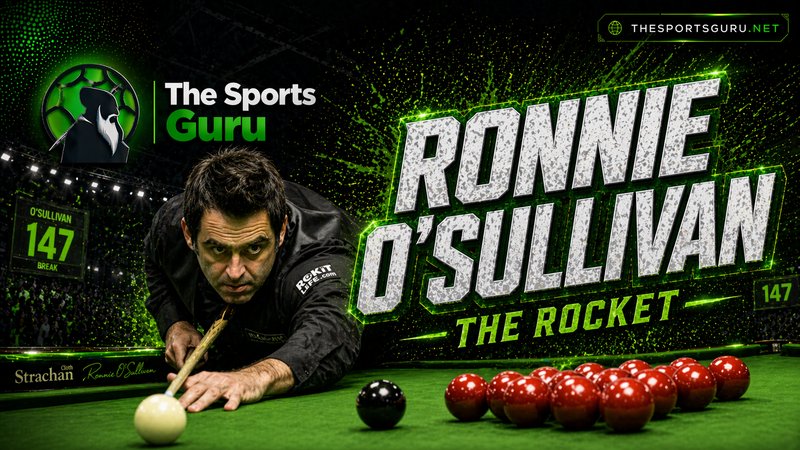
Ronnie O'Sullivan arrived at the Crucible carrying two cues after a troublesome tip wrecked his UK Championship campaign, and the unconventional precaution paid off handsomely. A 10-2 demolition of Chinese debutant He Guoqiang, featuring three century breaks in under an hour with his reserve cue, has kept the 50-year-old firmly on course for a record-breaking eighth world title. Next up is fellow veteran John Higgins in what promises to be a compelling Class of 92 reunion in the last 16.
The cue had spent most of the year gathering dust under a bed in Ireland. On Wednesday afternoon at the Crucible, it was responsible for three century breaks in under an hour. That is the peculiar, pragmatic world of Ronnie O'Sullivan, a player who treats equipment that most professionals treat as sacred as little more than a functional instrument, swappable at will.
O'Sullivan's 10-2 defeat of Chinese debutant He Guoqiang was one of the most commanding results of the 2026 World Snooker Championship so far, joint biggest in the tournament at this stage. Yet the real story sits behind the scoreline. Having led 7-2 after Tuesday's opening session, the seven-time world champion returned on Wednesday with a different cue to the one he had used the previous day, broke of 62, 113 and 100 in rapid succession, and cantered home in less than sixty minutes of play.
At 50 years old, in his 34th Crucible campaign, O'Sullivan is chasing a place in outright snooker history. Seven world titles already match Stephen Hendry's record haul in the modern era. An eighth would move him clear and cement a legacy that is already without parallel in the sport. Given what unfolded across two days against the 25-year-old He, that ambition looks entirely credible.
The Logic Behind the Two-Cue Strategy
O'Sullivan's decision to bring two cues to Sheffield was not a whim. It was a calculated response to a painful lesson learned in December. His opening-round defeat at the UK Championship to China's Zhou Yuelong, 6-4 at the York Barbican, had little to do with form or focus. The problem was the tip of his cue, which had deteriorated to the point where he simply could not execute the shots he wanted. A worn or poorly shaped tip removes the ability to apply side and screw with any consistency, which for a player whose entire game is built on cue ball control, is effectively a veto on his best snooker. That experience clearly left a mark.
Rather than risk finding himself in the same position at the most important event in the calendar, O'Sullivan retrieved a back-up cue from beneath his bed in Ireland and brought it to Sheffield as insurance. When Tuesday's session revealed his primary cue tip was again unreliable, the switch was made without drama. Three centuries followed. The gamble, by any measure, had come off.
"I've been saving this all year because it had a bit of life in it and I thought 'if I come here and my main cue is no good...'" O'Sullivan explained. "The tip wasn't good yesterday. I did a good job, considering. I thought 'a bit of a roll of the dice', it was a gamble. You have to back yourself. I make some crazy decisions in everybody else's eyes, but they make complete sense to me."
A Genius With Any Implement in His Hand
For those who have watched O'Sullivan across three decades, the notion that his performances might hinge on which cue he selects is faintly absurd. His positional play, his reading of the table, his instinct for the correct shot in any given situation remain conspicuously superior to almost any rival. In the penultimate frame against He, he potted nine reds and eight blacks and appeared to be heading for a 147 maximum before opting for a blue and finishing on 113. The decision not to pursue the maximum was typically O'Sullivan: pragmatic, unshowy, and entirely on his own terms. It also reflected a player managing his energy and focus across a session rather than chasing the gallery, which at this stage of a long tournament is arguably the wiser call.
Six-time world champion Steve Davis, who himself reached the World Championship quarter-finals in 2010 at the age of 52, offered an assessment that felt apt.
Davis's observation cuts to something important about O'Sullivan's continued relevance at 50. It is not merely that he remains competitive; it is that the core of what makes him exceptional, his tactical intelligence and his capacity to construct and extend breaks, appears largely immune to the passage of time. The cue is almost beside the point.
Paul Scholes in the Front Row and a Rare Moment of Distraction
The Crucible audience on Wednesday included a notable football guest. Former Manchester United and England midfielder Paul Scholes was seated in the front row, and even O'Sullivan, rarely unsettled by his surroundings, admitted to a double-take on spotting him.
"I went 'that's Paul Scholes here'," O'Sullivan said. "He looks really well, fit, healthy, so good to see him come to the snooker." It was a brief aside, delivered with genuine warmth, and stood as a reminder of the crossover appeal O'Sullivan brings to the sport. Few snooker players would cause a camera to pan instinctively to the audience; O'Sullivan's presence tends to attract presences in return.
It is also worth noting the broader context of O'Sullivan's season leading into Sheffield. He reached the World Open final in China in March, a tournament at which he also compiled that extraordinary 153 break, the highest in the history of the professional game, achieved after a free ball from a snooker acted as a sixteenth red. But that run was only his third tournament of 2026, having lost in the last 16 of the World Grand Prix and the last 32 at the German Masters earlier in January. By his own reckoning, he has been selective about where he commits his energies, and it appears to be a deliberate conservation strategy ahead of Sheffield. For a player at 50 competing across a gruelling best-of-19 and potentially best-of-25 format at the Crucible, rationing competitive miles earlier in the season is not eccentricity; it is calculation.
The Class of 92 Reunion Nobody Expected to Last This Long
O'Sullivan's next opponent is John Higgins, the four-time world champion who turned professional in the same year as O'Sullivan and Mark Williams. All three are still active in this year's draw, which is a statistical improbability that speaks to exceptional longevity from an exceptional generation. Williams, at 51, is the eldest; Higgins is 50; O'Sullivan has just turned 50 himself. That the trio, collectively known as snooker's Class of 92, remain capable of competing at the Crucible in 2026 is a feat worth pausing to appreciate.
O'Sullivan was characteristically self-deprecating about the prospect of facing Higgins, but the remarks carried an underlying competitive intelligence. "It's a couple of oldies, he's probably favourite," he said. "The pressure is off me and probably more on John in this match. John loves playing me, he really enjoys it. He plays better against me than I do against him." Whether that framing reflects genuine modesty or a subtle piece of psychological framing is difficult to determine. Probably both. What is notable is that O'Sullivan is voluntarily loading expectation onto Higgins at the very moment when, as the player chasing a record eighth title, the narrative weight might reasonably be expected to sit on his own shoulders.
Verdict: History Is Within Touching Distance
The last-16 tie against Higgins is the first genuine examination O'Sullivan will face at these championships. He Guoqiang, a 25-year-old making his Crucible debut, offered limited resistance across two sessions, and the margin of the victory, while impressive, tells us more about O'Sullivan's clinical efficiency than it does about his capacity to handle sustained pressure from a seasoned opponent. Higgins will provide that test in full.
What Wednesday confirmed, however, is that O'Sullivan's physical and mental sharpness remain exceptional for a player of his age. The willingness to switch cues mid-tournament, to trust in a reserve instrument that had barely been used all year, and to produce three centuries in under an hour regardless, suggests someone who is not merely going through the motions of a farewell Crucible tour. He is here to win, and the record books are clearly on his mind.
If O'Sullivan navigates the Higgins hurdle and progresses deep into the draw, the question of an eighth world title, and the outright record in the modern era that would come with it, will dominate the conversation in Sheffield for the next two weeks. On this evidence, that conversation is entirely justified. The cue may change from session to session. The quality does not.
Frequently Asked Questions
O'Sullivan's primary cue had a deteriorating tip that prevented him from applying side and screw consistently. After Tuesday's opening session exposed the problem, he switched to a back-up cue he had retrieved from beneath his bed in Ireland, where it had been stored for most of the year.
His 6-4 loss to Zhou Yuelong at the York Barbican in December was attributed not to poor form but to a worn cue tip that undermined his cue ball control. That experience prompted him to bring a reserve cue to Sheffield as insurance against the same problem recurring at the World Championship.
O'Sullivan currently shares the record for most world titles in the modern era with Stephen Hendry, both having won seven. An eighth title would move him clear of Hendry and into outright snooker history at the age of 50, in his 34th Crucible campaign.
In the penultimate frame, O'Sullivan potted nine reds and eight blacks and appeared to be on course for a 147 before opting for a blue instead, finishing on 113. The article does not explain why he chose to abandon the maximum at that point.
O'Sullivan's next opponent is John Higgins, with the article describing the tie as a "Class of 92 reunion." Both players emerged as professionals in the same era, making their meeting in the last 16 of the 2026 World Championship a contest between two of snooker's longest-serving and most decorated competitors.
Sources: Match details, statistics, and quotes from BBC Sport's coverage of the 2026 World Snooker Championship at the Crucible Theatre, Sheffield, reported by Michael Emons.